Creating a safe workplace starts with knowledge, awareness, and responsibility. A Safety Orientation Course is the foundation of workplace safety, ensuring employees understand risks, prevention methods, and emergency procedures before accidents happen.
In industries such as construction, oil and gas, manufacturing, marine, and logistics, safety orientation training is not optional—it is essential. Whether you are a new employee, contractor, supervisor, or employer, a workplace safety orientation course helps protect lives, reduce costs, and build a strong safety culture.
What Is a Safety Orientation Course?
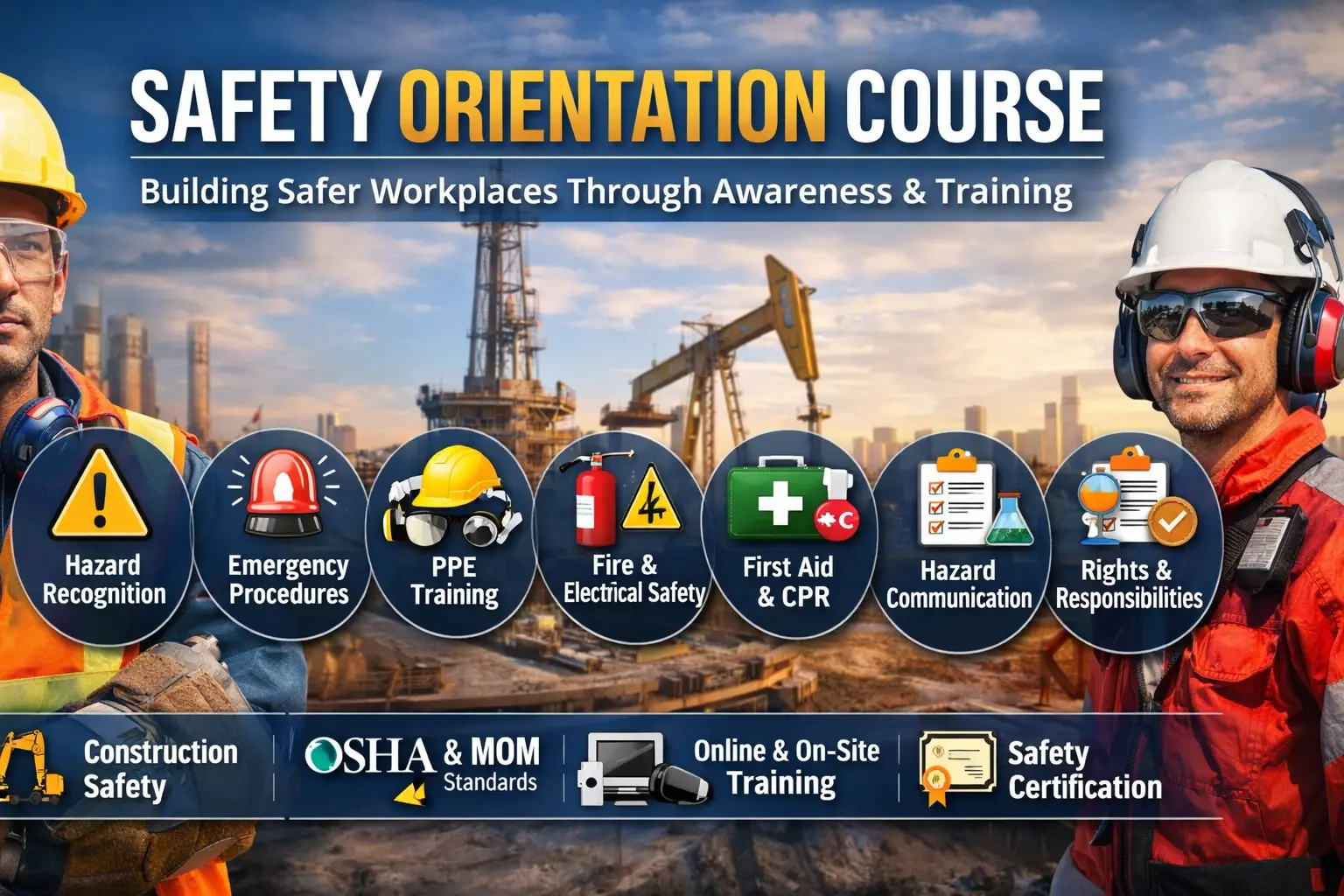
A Safety Orientation Course is a structured workplace safety training program designed to educate workers about:
- Occupational hazards
- Emergency response procedures
- Personal Protective Equipment (PPE)
- Fire and electrical safety
- First aid and CPR basics
- Hazard communication
- Employee rights and responsibilities
The goal is to ensure that every worker can identify risks, prevent accidents, and respond correctly in emergencies.
Unlike regular training sessions, safety orientation focuses on prevention-first thinking, helping employees develop a safety mindset rather than simply following rules.
Why Safety Orientation Training Matters
Every workplace contains hazards—some obvious, others hidden. Without proper safety awareness training, even experienced workers can make mistakes that lead to injuries or fatalities.
Key Benefits of Safety Orientation Training:
- Reduces workplace accidents and injuries
- Improves compliance with OSHA, MOM, and local safety laws
- Builds employee confidence and morale
- Lowers insurance claims and legal risks
- Enhances productivity and teamwork
Organizations that invest in occupational safety courses consistently report fewer incidents, less downtime, and higher employee satisfaction.
Core Topics Covered in a Safety Orientation Course
A high-quality safety orientation training program covers all essential aspects of workplace safety.
1. Hazard Recognition Training
Employees learn how to identify:
- Mechanical hazards
- Electrical risks
- Chemical exposure
- Slip, trip, and fall dangers
This training is especially critical in construction safety orientation courses and industrial safety training.
2. Emergency Response Procedures
Workers are trained to handle:
- Fires
- Explosions
- Medical emergencies
- Natural disasters
Knowing evacuation routes, alarms, and first aid locations can save lives.
3. Personal Protective Equipment (PPE)
Proper use of:
- Helmets
- Gloves
- Safety shoes
- Eye and respiratory protection
PPE training ensures equipment is used correctly—not just worn.
4. Fire and Electrical Safety Training
Includes:
- Fire prevention
- Fire extinguisher operation
- Lockout/tagout procedures
- Electrical hazard awareness
5. First Aid and CPR Basics
Many safety orientation courses introduce basic first aid principles, enabling workers to respond immediately while waiting for professionals.
6. Hazard Communication Training
Covers:
- Safety Data Sheets (SDS)
- Chemical labeling
- Safe storage practices
Mandatory in workplaces handling hazardous substances.
7. Rights and Responsibilities
Employees learn about:
- OSHA regulations (USA)
- MOM safety laws (Singapore)
- Employer responsibilities
- Worker rights to refuse unsafe work
Types of Safety Orientation Courses
Different industries require different safety training approaches.
General Industry Safety Orientation
Designed for:
- Offices
- Warehouses
- Factories
Focuses on:
- Ergonomics
- Manual handling
- Emergency awareness
Construction Safety Orientation Course
Specifically for construction workers, covering:
- Working at heights
- Scaffolding safety
- Heavy equipment handling
- Site signage
Many employers require a construction safety orientation course for workers before site access.
Common Safety Orientation Course (CSOC) – Singapore
In Singapore, the Common Safety Orientation Course (CSOC) is mandatory for construction workers.
Regulated by the Ministry of Manpower (MOM), it ensures:
- Standardized safety training
- Practical demonstrations
- Hazard simulations
- Formal assessments
This makes the safety orientation course Singapore model one of the most respected globally.
Safety Orientation Course MOM
The MOM Safety Orientation Course applies to:
- Construction
- Marine
- Manufacturing
Participants often praise its practical, real-world focus rather than theory-only teaching.
How a Safety Orientation Course Is Conducted
Training methods typically include:
- Classroom lectures
- Safety videos
- Practical demonstrations
- Mock hazard identification
- Emergency drills
Online Safety Orientation Courses
Modern platforms offer online safety orientation courses, allowing workers to:
- Learn at their own pace
- Complete modules remotely
- Take assessments digitally
However, hands-on training remains essential for high-risk industries.
Who Should Take a Safety Orientation Course?
Safety orientation is for everyone, including:
- New employees
- Experienced workers
- Supervisors and managers
- Contractors and subcontractors
- Temporary and part-time staff
Many companies require visitor safety orientation before entry into hazardous facilities.
Certification and Duration
Duration
- General courses: 1–4 hours
- Industry-specific courses: 4–8 hours
- Advanced programs (OSHA 30): Several days
Certification
Upon completion, participants receive:
- Safety training certificate
- Safety card or digital proof
OSHA certifications are widely recognized in the USA, while MOM certificates are mandatory in Singapore and valid for specific periods.
Global Perspective on Safety Orientation Training
United States
- Regulated by OSHA
- Focus on hazard communication and emergency preparedness
Canada
- Emphasis on worker rights and mental health safety
Singapore
- MOM-enforced safety orientation courses
- Strict certification standards
UAE
- Strong focus on oil and gas safety orientation
Despite regional differences, the goal remains the same: sending workers home safely every day.
Impact on Workplace Safety Culture
A strong safety orientation program transforms organizations from reactive to proactive.
Cultural Benefits:
- Increased accountability
- Better communication
- Fewer incidents
- Stronger teamwork
Employees begin to look out for each other, not just themselves.
Challenges and Misconceptions
❌ “Safety training wastes time”
✔ Reality: It prevents downtime caused by accidents.
❌ “One-time training is enough”
✔ Reality: Safety requires continuous learning.
Companies that treat safety orientation as an investment—not a formality—see measurable improvements.
Modern Trends in Safety Orientation
- Virtual Reality (VR) safety simulations
- Augmented Reality (AR) hazard training
- Behavior-Based Safety (BBS) programs
- Personalized role-based modules
Technology is making safety training more engaging, realistic, and effective.
Real User Experiences
Construction Worker – Singapore
“The common safety orientation course helped me recognize risks I never noticed before. The real examples made everything clear.”
Manufacturing Supervisor – USA
“Our safety orientation training prevented a small fire from becoming a disaster. The team knew exactly what to do.”
Oil & Gas Technician – UAE
“This course focused on communication and teamwork, not just rules. It changed how I approach safety.”
Conclusion
A Safety Orientation Course is more than a compliance requirement—it is a lifesaving investment. Whether it’s a construction safety orientation course, OSHA safety training, or a MOM-approved safety orientation course in Singapore, the purpose remains the same:
Protect people. Prevent accidents. Build a culture of safety.
As workplaces evolve, continuous safety education will remain one of the most powerful tools for ensuring health, productivity, and trust.
FAQs
1. What is the main purpose of a Safety Orientation Course?
To educate workers on hazard identification, safety procedures, and emergency response.
2. Who should attend a safety orientation course?
All employees, contractors, supervisors, and visitors to high-risk workplaces.
3. How long does a safety orientation course take?
From 1 to 8 hours, depending on industry and certification level.
4. What is the difference between general and construction safety orientation courses?
Construction courses focus on high-risk activities like working at heights and heavy machinery.
5. What is the MOM safety orientation course in Singapore?
A mandatory program regulated by the Ministry of Manpower for construction and industrial workers.
6. Is a safety orientation certificate internationally recognized?
While certifications are region-specific, many global employers accept them as proof of safety training.