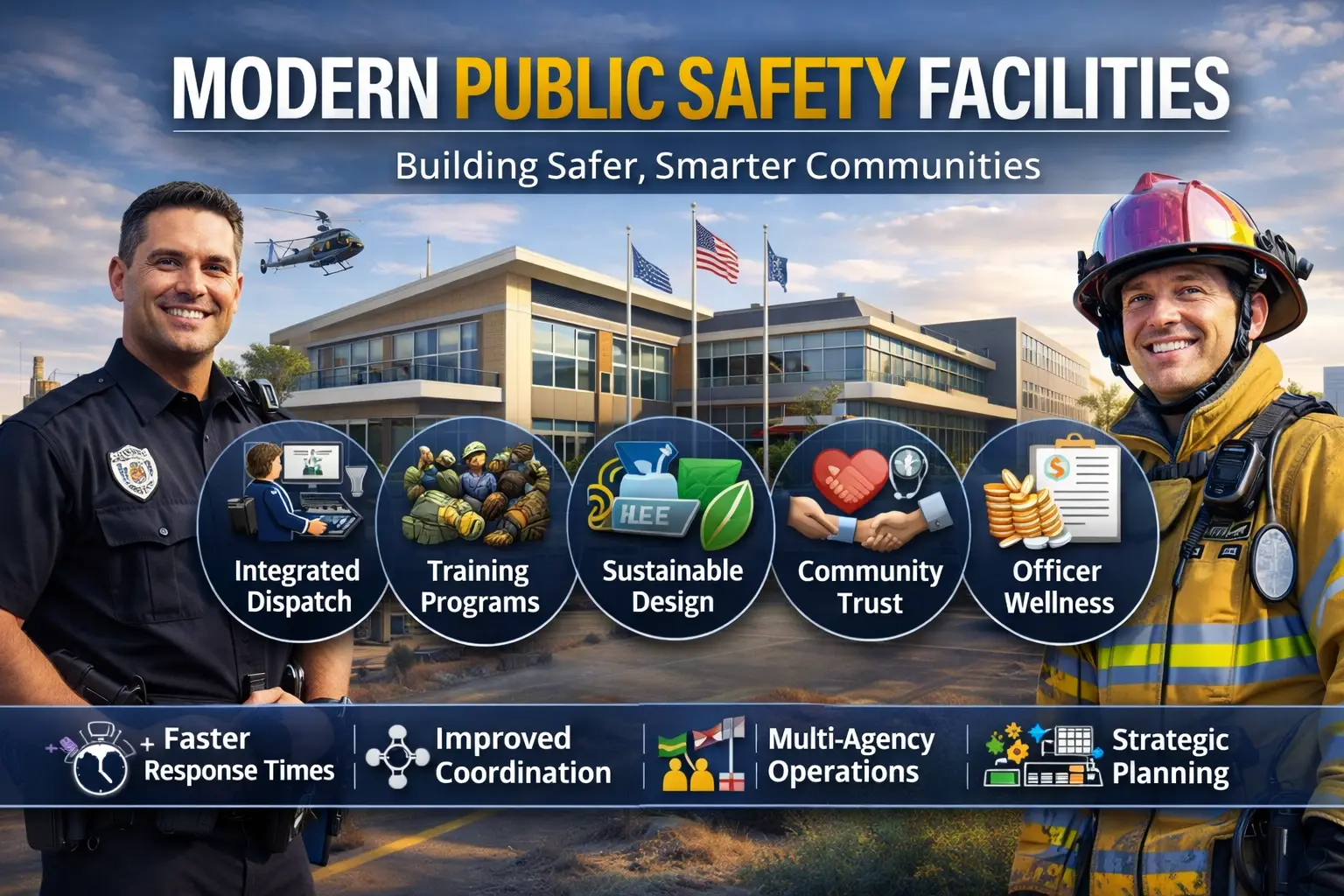
When communities invest in public safety infrastructure, they’re not just constructing buildings—they’re making a foundational commitment to protecting lives, improving emergency response times, and supporting the brave men and women who serve on the front lines every day. Modern public safety facilities represent a transformative shift in how we approach community safety, integrating cutting-edge technology, sustainable design, and human-centered spaces that benefit both first responders and the communities they serve.
What is a Public Safety Facility?
A public safety facility is a specialized government building designed to house essential emergency services including police departments, fire departments, emergency medical services, dispatch centers, and emergency management offices. Unlike traditional standalone stations, modern public safety facilities often integrate multiple agencies under one roof, creating seamless coordination during emergencies and everyday operations.
These facilities serve as the operational heart of community emergency preparedness, providing spaces for training, equipment storage, administrative functions, and real-time emergency response coordination. From the Hennepin County Public Safety Facility in Minnesota to the City of Mesa Public Safety Training Facility in Arizona, communities nationwide are recognizing that upgraded infrastructure directly translates to saved lives and improved public safety outcomes.
Why Public Safety Facilities Are Important
The importance of dedicated public safety infrastructure cannot be overstated. When seconds matter during a medical emergency, fire, or crime in progress, the efficiency of your local emergency services facility can mean the difference between life and death. Modern facilities address critical gaps that aging infrastructure simply cannot meet.
First responders operating from outdated facilities face daily challenges: inadequate space for modern equipment, poor communication systems that delay response coordination, and facilities that lack basic amenities for officer wellness. By contrast, purpose-built community safety facilities provide the operational efficiency needed for rapid response while supporting the physical and mental health of emergency personnel.
Communities benefit in multiple ways. Integrated public safety facilities reduce response times through better resource allocation and multi-agency coordination. They provide secure, climate-controlled environments for sensitive equipment and evidence storage. Perhaps most importantly, they signal a community’s commitment to public safety, building trust between residents and the professionals who protect them.
Benefits of Public Safety Facilities for Communities
Modern public safety buildings deliver tangible benefits that extend far beyond emergency response:
Enhanced Emergency Response: Integrated dispatch centers with real-time data sharing enable coordinated responses across police, fire, and EMS. When all agencies operate from a shared emergency operations center, critical information flows seamlessly, eliminating communication delays that previously cost precious minutes.
Improved Training Opportunities: Dedicated public safety training facilities like the Gilbert Public Safety Training Facility and South Metro Public Safety Training Facility provide simulation-based safety training that prepares responders for real-world scenarios. Firefighter training facilities can recreate building fires, while law enforcement training facilities offer realistic scenario-based exercises.
Cost Efficiency Through Consolidation: Combining multiple departments reduces operational redundancies. Shared emergency communication systems, consolidated administrative functions, and unified facility management lower long-term costs while improving service delivery.
Community Access and Transparency: Many facilities include public-facing areas where residents can access government services, attend community safety awareness courses, and participate in civic engagement programs. This accessibility builds community trust in public safety agencies.
Officer Wellness and Retention: First responder mental health has become a critical focus. Modern facilities incorporate fitness facilities for first responders, quiet spaces for mental health support, and natural lighting in public buildings that reduces stress and prevents burnout. These human-centered features help attract and retain qualified personnel in an increasingly competitive job market.
What Makes Modern Public Safety Facilities Unique
The evolution from traditional fire and police stations to comprehensive community safety infrastructure reflects dramatic changes in technology, operational needs, and our understanding of emergency response.
Technology Integration: Smart public safety buildings incorporate sophisticated emergency communication systems, surveillance systems with facial recognition capabilities, and AI emergency dispatch that can predict resource needs based on incident patterns. Digital jail roster systems and integrated databases allow information sharing across jurisdictions, critical for tracking suspects and coordinating regional responses.
Multi-Agency Coordination: Facilities like the North Metro Regional Public Safety Training Facility demonstrate the trend toward regionalization. By serving multiple communities, these centers provide training resources and emergency backup that individual municipalities couldn’t afford independently. Crisis response facilities designed for multi-agency coordination prevent the communication failures that have plagued major disasters.
Sustainable Design Excellence: Modern public safety facility design increasingly incorporates green building principles. LEED certified public buildings reduce operating costs while demonstrating environmental responsibility. Solar powered public facilities in sunny regions like the City of Surprise Public Safety Facility in Arizona can offset significant energy expenses. Energy-efficient HVAC systems maintain comfortable environments for around-the-clock operations while minimizing carbon footprints.
Electric vehicle charging stations support the growing fleet of hybrid and electric emergency vehicles, while sustainable infrastructure design principles ensure facilities remain operationally viable for decades.
Resilient Construction: Public safety buildings must function during the very disasters they respond to. This requires hardened construction, backup power systems, reinforced communications infrastructure, and strategic positioning away from flood zones and fault lines. Emergency preparedness infrastructure built to these standards becomes a community refuge during natural disasters.
Regional Public Safety Facility Development
Communities across the nation are investing in next-generation facilities tailored to local needs:
Minnesota Public Safety Infrastructure: The Big Lake Public Safety Facility Project and Hennepin County Public Safety Facility represent Minnesota’s commitment to modernizing emergency services. These public safety facility Minnesota projects address the unique challenges of harsh winters, rural response areas, and growing suburban populations.
Arizona Public Safety Expansion: Rapid population growth has driven extensive development of public safety facility Arizona projects. The City of Mesa Public Safety Training Facility, Gilbert Public Safety Training Facility, and MCC Public Safety Training Facility serve the Phoenix metropolitan area’s training needs, while the City of Surprise Public Safety Facility provides integrated services to one of America’s fastest-growing communities.
California Innovation: High land costs and seismic concerns shape public safety facility California projects. The Santa Monica Public Safety Facility demonstrates how coastal communities integrate beach patrol, harbor security, and traditional emergency services. California’s strict building codes ensure these facilities can withstand earthquakes while maintaining operations.
Oregon’s Sustainable Approach: The Redmond Public Safety Facility and other public safety facility Oregon projects emphasize sustainability and community integration, reflecting the state’s environmental values while addressing rural fire protection and urban growth.
How Do Public Safety Training Facilities Work
Public safety training programs require specialized infrastructure that traditional stations cannot provide. Comprehensive training facilities create realistic environments where responders can practice high-stakes scenarios without risking public safety.
Fire Service Training: Firefighter training facilities include burn buildings where controlled fires allow practice in live-fire conditions, driver training courses for apparatus operation, confined space simulators, and hazardous materials response areas. These controlled environments build muscle memory and decision-making skills that save lives during actual emergencies.
Law Enforcement Training: Law enforcement training facilities feature firearms ranges, defensive tactics rooms, driving simulators, and mock buildings for active shooter and barricaded suspect scenarios. Simulation-based safety training using virtual reality creates immersive experiences that prepare officers for split-second decisions.
Emergency Medical Services: EMS training areas provide patient simulation with high-fidelity mannequins, ambulance operations training, and mass casualty incident scenarios. Integrated training where police, fire, and EMS practice together improves the coordination essential to major incident response.
Community Education: Many facilities also host community emergency preparedness training, teaching CPR, first aid, disaster preparedness, and emergency evacuation planning. This dual use maximizes facility value while building community resilience.
Public Safety Facility Funding and Planning
Developing modern emergency services facilities requires careful financial planning and community support. Understanding public safety facility funding mechanisms helps communities move from vision to reality.
Lease Revenue Bonds: Many jurisdictions use lease revenue bonds for public safety facility funding. These instruments allow governments to borrow money for construction, with the facility itself serving as collateral. The debt is repaid through facility leases or dedicated revenue streams, avoiding the need for tax increases.
Government Infrastructure Investment: Federal and state programs sometimes provide grants or matching funds for municipal safety projects. The Infrastructure Investment and Jobs Act has made additional funding available for critical public buildings, including emergency services infrastructure.
Public-Private Partnerships: Some communities explore partnerships where private developers construct facilities that governments then lease, transferring construction risk while preserving public ownership options.
Long-Term Infrastructure Planning: Successful projects begin years before construction, with comprehensive planning that assesses community needs, projects growth, evaluates sites, and builds public support. Public safety facility planning typically involves:
- Needs assessment and gap analysis
- Community engagement and stakeholder input
- Architectural programming and design
- Environmental impact studies
- Financing strategy development
- Construction phasing to maintain services
- Post-occupancy evaluation and adjustment
The Role of Sustainability in Public Safety Buildings
Sustainable public safety facilities deliver environmental benefits while reducing operational costs that can be redirected to personnel and equipment.
Energy Performance: Energy-efficient HVAC systems in facilities operating 24/7 generate substantial savings. Modern systems use zone controls, heat recovery, and smart thermostats to minimize waste. LED lighting with occupancy sensors and natural lighting strategies reduce electricity consumption by up to 60% compared to older facilities.
Renewable Energy Integration: Solar powered public facilities in appropriate climates can approach net-zero energy consumption. Battery storage systems provide backup power during outages, ensuring uninterrupted operations. Some facilities sell excess generation back to utilities, creating revenue streams.
Water Conservation: Low-flow fixtures, rainwater harvesting for vehicle washing and landscape irrigation, and native landscaping reduce water consumption and utility costs.
Material Selection: Sustainable infrastructure design emphasizes durable, locally sourced, and recycled materials. These choices reduce embodied carbon while supporting local economies. Many modern facilities achieve LEED Silver, Gold, or Platinum certification, demonstrating environmental leadership.
Resilience Co-Benefits: Sustainability and resilience overlap significantly. Solar panels with battery backup, water storage, and efficient building envelopes make facilities more resistant to utility disruptions during disasters—exactly when they’re needed most.
Future of Public Safety Infrastructure
The evolution of community safety facilities continues to accelerate, driven by technological advancement and changing community needs.
Artificial Intelligence and Predictive Analytics: AI emergency dispatch systems analyze call patterns, historical data, and real-time information to predict where emergencies will occur and pre-position resources. Machine learning improves over time, optimizing response strategies and resource allocation.
Smart Building Technology: The Internet of Things enables buildings that monitor and adjust their own systems. Smart public safety buildings track equipment status, predict maintenance needs, and automatically optimize energy use. Integrated sensors can detect equipment failures before they cause operational disruptions.
Virtual and Augmented Reality Training: Next-generation simulation-based safety training uses VR and AR to create infinitely customizable scenarios at a fraction of traditional training costs. Officers can practice de-escalation techniques, firefighters can navigate unfamiliar building layouts, and medics can rehearse trauma care procedures.
Community-Centered Design: Future facilities will blur the line between government buildings and community spaces. Mixed-use designs might include public libraries, community centers, or health clinics alongside emergency services, maximizing public value while building trust through daily interaction.
Resilience Planning: As climate change increases disaster frequency and severity, public safety modernization will emphasize facilities that can shelter displaced residents, provide emergency medical care during infrastructure failures, and serve as recovery coordination centers.
Public Safety Officer Wellness: The Human Element
Even the most technologically advanced facility fails if it doesn’t support the people working inside it. Emergency responder mental health and burnout prevention for first responders have become central to modern facility design.
Mental Health Support Spaces: Dedicated quiet rooms, peer support offices, and accessible mental health counseling areas acknowledge the psychological toll of emergency work. These spaces reduce stigma by normalizing mental health care as part of professional development.
Physical Fitness: Fitness facilities for first responders maintain the physical conditioning essential to emergency work. Well-equipped gyms, appropriate space for physical training, and shower facilities support shift-based wellness programs.
Natural Light and Biophilic Design: Research consistently shows that natural lighting in public buildings improves mood, reduces stress, and enhances cognitive function. Windows, skylights, and atriums bring daylight into workspaces. Biophilic design elements like indoor plants, natural materials, and views of nature further support wellbeing.
Ergonomic Workspaces: Adjustable workstations, proper lighting for detailed work, and acoustically controlled environments prevent the cumulative physical strain of long shifts. Dispatch centers particularly benefit from ergonomic design given the extended periods operators spend at consoles.
Sleep and Recovery: For facilities with sleeping quarters, proper bedroom design with blackout capabilities, white noise systems, and comfortable furnishings supports the restorative sleep critical to alertness and decision-making.
Community Benefits of Public Safety Facilities
The ripple effects of modern community safety infrastructure extend throughout entire regions:
Economic Development: Quality public safety services attract businesses and residents. Companies consider emergency response capabilities when choosing locations, and families prioritize safety when selecting communities. Modern facilities signal a community’s investment in quality of life.
Property Values: Proximity to responsive, well-equipped emergency services measurably increases property values. The economic value added often exceeds facility construction costs within years.
Educational Partnerships: Training facilities often partner with colleges and universities, creating pathways to public safety careers while providing practical training for criminal justice, fire science, and emergency medical programs. These partnerships build workforce pipelines while strengthening educational institutions.
Regional Collaboration: Shared facilities foster relationships between neighboring jurisdictions. During major incidents, these pre-existing partnerships enable seamless mutual aid and resource sharing.
Civic Pride: High-quality civic infrastructure development demonstrates good governance and responsible stewardship of public resources. Communities take pride in facilities that reflect their values and commitment to safety.
Key Considerations for Communities Planning Public Safety Facilities
Communities beginning the planning process should consider several critical factors:
Needs Assessment: Comprehensive evaluation of current deficiencies, projected growth, changing service demands, and regional cooperation opportunities. This assessment should project needs 30-50 years into the future, as facilities will serve communities for generations.
Site Selection: Location dramatically impacts response times and operational efficiency. Ideal sites provide central positioning for coverage areas, adequate space for current and future needs, accessibility to major transportation routes, and resilience to natural hazards.
Flexibility and Adaptability: Technology and operational practices will continue evolving. Designing spaces that can be reconfigured, incorporating infrastructure for future technology integration, and building modular systems allows facilities to adapt without major reconstruction.
Community Engagement: Successful projects involve extensive public input. Community meetings, surveys, facility tours, and transparent communication build support while incorporating valuable local knowledge.
Operational Planning: Design should flow from operational needs, not the reverse. Involving frontline personnel early ensures facilities support actual workflows and don’t repeat past mistakes.
Making the Investment: Next Steps for Your Community
If your community is considering public safety infrastructure investment, the pathway forward involves several key steps:
Build Awareness: Educate stakeholders about the benefits of modern facilities and the costs of delaying needed improvements. Site visits to recently completed facilities demonstrate possibilities and build enthusiasm.
Form a Planning Committee: Include representatives from all affected departments, local government leadership, community members, and technical experts. This diverse group ensures all perspectives inform decisions.
Conduct Professional Studies: Engage architects specializing in public safety design, needs assessment consultants, and financial advisors to develop realistic plans and budgets.
Develop Financing Strategy: Explore available funding mechanisms, including grants, bonds, partnerships, and phased approaches that spread costs over time.
Communicate Transparently: Regular updates, public meetings, and accessible information build trust and maintain support throughout the multi-year process from planning through construction.
Conclusion: Building the Foundation for Safer Communities
Modern public safety facilities represent one of the most important investments communities can make. They enable faster emergency response, support the wellness of first responders, demonstrate environmental responsibility, and signal a commitment to protecting what matters most—the safety and wellbeing of residents.
From the integrated emergency operations centers that coordinate disaster response to the training facilities preparing the next generation of firefighters and police officers, these buildings serve as the foundation for community resilience. As communities nationwide recognize the limitations of aging infrastructure, investment in purpose-built, technologically advanced, and sustainably designed public safety facilities continues to grow.
Whether you’re a municipal leader evaluating options, a first responder working in inadequate facilities, or a resident concerned about community safety, understanding the transformative potential of modern public safety infrastructure is essential. These facilities don’t just house emergency services—they enable the rapid, coordinated, professional response that saves lives and protects property every single day.
The communities investing in public safety facilities today are building more than buildings. They’re constructing the infrastructure of safety, resilience, and peace of mind that will serve generations to come.
Frequently Asked Questions
What is a public safety facility?
A public safety facility is a specialized government building that houses essential emergency services including police, fire, emergency medical services, dispatch operations, and emergency management functions, often integrating multiple agencies to improve coordination and response effectiveness.
Why are cities investing in public safety facilities?
Cities invest in modern facilities to reduce emergency response times, accommodate advancing technology, improve multi-agency coordination, support first responder wellness, address aging infrastructure, and meet the needs of growing populations.
What makes modern public safety facilities unique?
Modern facilities distinguish themselves through integrated technology systems, multi-agency collaboration spaces, sustainable design features, specialized training capabilities, enhanced officer wellness amenities, and resilient construction that ensures operation during disasters.
How do public safety training facilities work?
Training facilities provide realistic environments where first responders practice emergency scenarios through live-fire training, tactical simulations, medical response exercises, and coordinated multi-agency drills, building skills and muscle memory in controlled settings before facing real emergencies.
What role does sustainability play in public safety buildings?
Sustainable design reduces long-term operating costs through energy efficiency, incorporates renewable energy systems, minimizes environmental impact, improves indoor air quality for occupant health, and enhances facility resilience through redundant systems and efficient resource use.
How do public safety facilities benefit residents?
Residents benefit from faster emergency response times, improved coordination during crises, access to community education programs, enhanced property values, economic development attracted by quality services, and the peace of mind that comes from well-equipped, professionally supported first responders protecting their community.