
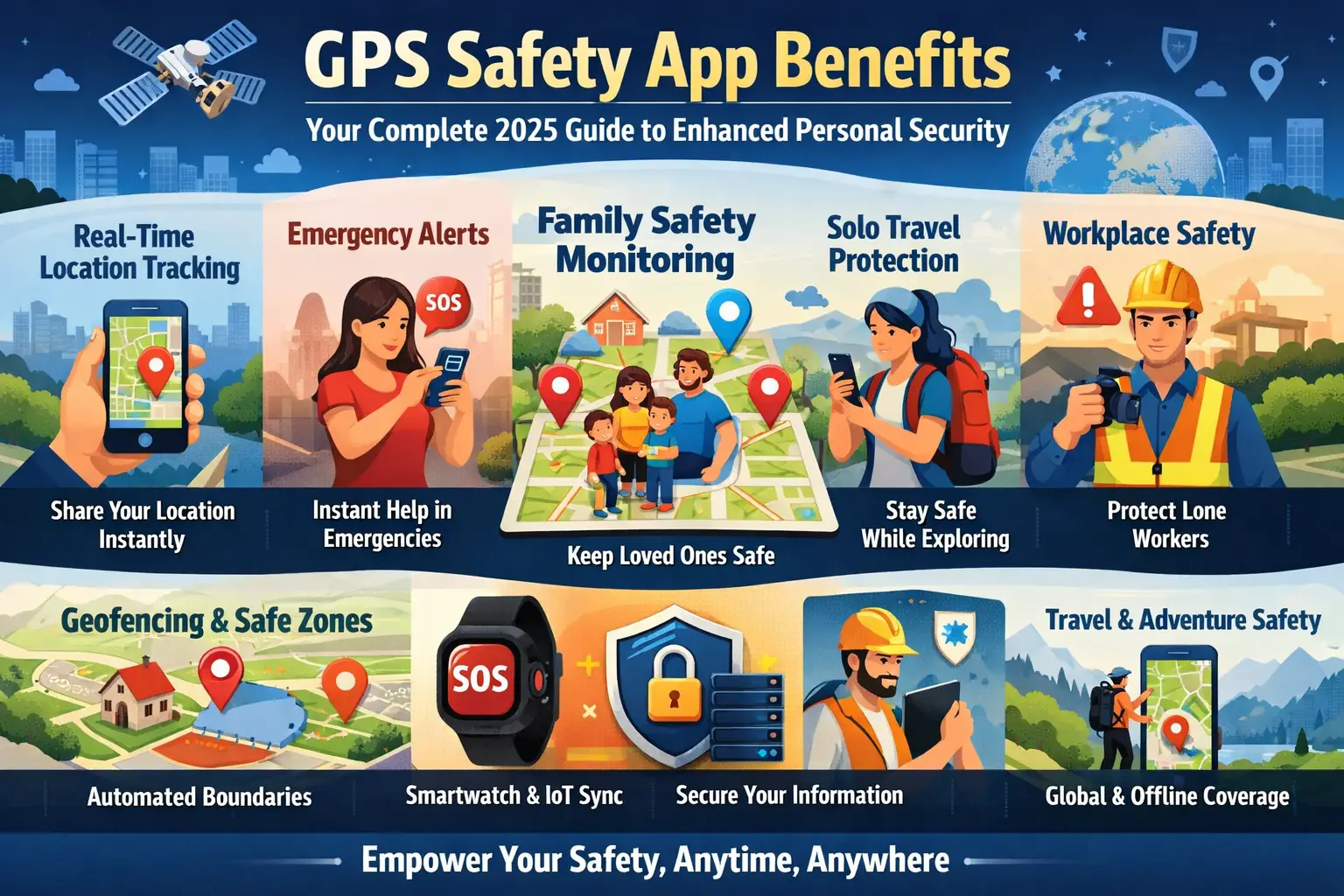
Personal safety has evolved beyond traditional methods like pepper spray and self-defense classes. Today, GPS safety app benefits extend far beyond simple location tracking, offering comprehensive protection through real-time monitoring, emergency alerts, and automated safety features that work 24/7. Whether you’re a parent monitoring children, a solo traveler exploring new cities, or someone working late shifts, understanding GPS safety app benefits can dramatically improve your security strategy.
Understanding GPS Safety Apps and Their Core Functions
GPS safety apps leverage satellite positioning technology combined with cellular networks and internet connectivity to provide continuous location monitoring and emergency response capabilities. These applications transform your smartphone into a powerful safety device that connects you with emergency services, trusted contacts, and professional monitoring teams when seconds matter most.
The fundamental GPS safety app benefits start with real-time location sharing. Unlike periodic check-ins or manual updates, modern GPS safety apps continuously track your position and share it with designated contacts. This constant awareness creates a safety net where your loved ones always know your whereabouts, and help can be dispatched to your exact location if needed.
Beyond basic tracking, GPS safety apps incorporate geofencing technology that creates virtual boundaries around specific locations. When you enter or leave these designated zones, the app automatically notifies your safety contacts. Parents use this feature to confirm children arrived safely at school, while employers track field workers entering potentially hazardous job sites. This automated monitoring removes the need for constant manual updates while ensuring accountability.
Emergency Alert Systems: The Most Critical GPS Safety App Benefits
One of the most valuable GPS safety app benefits involves emergency alert capabilities that can summon help with a single button press or even automatic detection. When you activate an emergency alert, the app simultaneously notifies your pre-selected contacts, shares your precise GPS coordinates, and can connect you directly with emergency services depending on the app’s features.
Advanced GPS safety apps now incorporate fall detection, sudden movement alerts, and even audio monitoring that can detect distress patterns in your voice or surroundings. These automatic triggers provide protection even when you cannot manually activate an alert, such as during medical emergencies, accidents, or situations where accessing your phone isn’t possible.
The speed advantage represents another crucial element of GPS safety app benefits. Traditional emergency calls require explaining your location, which becomes difficult or impossible in high-stress situations. GPS safety apps eliminate this delay by instantly transmitting your coordinates to emergency responders and trusted contacts, reducing response times when every second counts.
Family Protection Through Location Sharing
For families, GPS safety app benefits create peace of mind through transparent location sharing among family members. Parents can monitor elderly relatives with dementia who may wander, track teenagers driving to ensure safe routes, and verify young children’s whereabouts during school hours or playdates.
The bidirectional nature of family GPS safety apps means everyone participates in shared security. Rather than one-way monitoring that feels invasive, family members can see each other’s locations, creating mutual accountability and safety awareness. When a family member doesn’t arrive at an expected destination on time, others receive automatic alerts rather than discovering the problem hours later.
Location history features within GPS safety apps provide valuable context during investigations or when retracing movements becomes necessary. If a family member goes missing, law enforcement can access historical location data to identify patterns, last known positions, and potential search areas. This digital trail has proven instrumental in numerous missing person cases.
GPS Safety App Benefits for Solo Travelers and Adventure Seekers
Solo travelers face unique safety challenges in unfamiliar environments where they lack local knowledge and support networks. GPS safety app benefits become especially valuable during international travel, wilderness adventures, and solo exploration of new cities.
Travel-specific GPS safety apps include features like embassy locators, local emergency numbers, and translation tools alongside core location tracking. When traveling internationally, these apps automatically adjust to local emergency services protocols and can alert contacts back home if you deviate significantly from planned routes or fail to check in as expected.
For outdoor enthusiasts, GPS safety apps with offline mapping capabilities maintain functionality even without cellular coverage. By downloading maps before heading into remote areas, hikers and campers can still track their routes, mark important waypoints, and share their planned paths with emergency contacts who will be alerted if they fail to return by specified times.
Workplace Safety Applications and Compliance Benefits
Businesses increasingly recognize GPS safety app benefits for protecting lone workers, field service technicians, and employees working in potentially hazardous environments. Industries like healthcare, utilities, construction, and delivery services use these apps to maintain duty-of-care obligations while improving emergency response coordination.
Employers can monitor worker locations during shifts, verify they’re following safety protocols by staying within designated areas, and receive instant alerts when workers enter restricted zones or fail to check in at scheduled intervals. This oversight isn’t about micromanagement but ensuring rapid response when accidents or emergencies occur in remote or dangerous locations.
From a compliance perspective, GPS safety apps provide documented evidence that employers took reasonable precautions to protect workers. In liability situations or insurance claims, location data and emergency response records demonstrate due diligence and can significantly impact legal outcomes.
Personal Security Features Beyond Location Tracking
Modern GPS safety app benefits extend into comprehensive personal security ecosystems. Many apps include features like fake call generators that create the appearance of an incoming call, giving users a natural exit from uncomfortable situations. Voice-activated emergency triggers allow discreet alert activation when manually accessing your phone would attract unwanted attention.
Integration with smart home security systems represents another dimension of GPS safety app benefits. Geofencing can automatically arm your home security system when you leave and disarm it upon return, while location data can trigger lights, adjust thermostats, and activate cameras based on your proximity to home.
Digital evidence collection capabilities within GPS safety apps serve important functions during and after incidents. Apps can automatically record audio, capture photos, and preserve location data when emergency alerts are activated, creating contemporaneous evidence for law enforcement investigations or legal proceedings.
Data Privacy and Security Considerations
While GPS safety app benefits are substantial, understanding privacy implications remains essential. Location data represents highly sensitive personal information that requires robust protection against unauthorized access, data breaches, and misuse.
Reputable GPS safety apps employ end-to-end encryption for location data transmission, secure cloud storage with regular audits, and granular privacy controls letting users specify who can access their location and under what circumstances. Reading privacy policies carefully helps ensure apps align with your comfort level regarding data collection, retention, and potential third-party sharing.
Consider whether GPS safety apps store location history indefinitely or delete data after specific periods. Some users prefer minimal data retention to reduce privacy risks, while others value historical records for pattern analysis and evidence preservation. Understanding these trade-offs helps select apps matching your priorities.
Cost-Benefit Analysis of GPS Safety App Subscriptions
GPS safety app benefits must be weighed against subscription costs ranging from free basic versions to premium services costing $10-30 monthly. Free apps typically offer core location sharing and basic emergency alerts but may include advertisements, limited contact lists, or reduced customer support.
Premium subscriptions unlock advanced features like professional monitoring services that contact emergency responders on your behalf, extended location history, unlimited safe zones, and priority customer support. For families or individuals facing elevated safety risks, these enhanced capabilities often justify subscription costs by providing professional-grade protection at a fraction of what traditional security services charge.
Consider the insurance principle: GPS safety app benefits provide value not through constant use but through availability during critical moments. A $15 monthly subscription becomes negligible when weighed against potential outcomes in emergencies where the app facilitates faster response, provides evidence for investigations, or simply offers peace of mind.
Integration with Wearable Devices and IoT Ecosystems
The expansion of GPS safety app benefits into wearable devices like smartwatches creates even more seamless protection. Wearables with built-in GPS and cellular connectivity enable emergency alerts without requiring smartphone access, particularly valuable during physical activities where carrying phones is impractical.
Smartwatch GPS safety apps can detect abnormal heart rates, sudden stops during running or cycling, and falls that might indicate medical emergencies or accidents. Automatic alert triggers combined with precise location sharing enable rapid response even when users cannot manually call for help.
Integration with vehicle systems represents another evolution in GPS safety app benefits. Modern cars can share location data directly with safety apps, automatically detecting crashes through airbag deployment or sudden deceleration and instantly alerting emergency contacts with accident locations.
Choosing the Right GPS Safety App for Your Needs
Maximizing GPS safety app benefits requires selecting applications aligned with your specific safety concerns and usage patterns. Parents prioritizing child safety should seek apps with robust geofencing, school arrival notifications, and age-appropriate features. Solo travelers benefit most from apps with international coverage, offline capabilities, and embassy/consulate databases.
Evaluate emergency contact limits, as basic apps may restrict you to 3-5 contacts while premium versions allow unlimited emergency networks. Consider whether apps support two-way communication, enabling emergency contacts to send messages or instructions during incidents.
Battery consumption significantly impacts GPS safety app benefits. Continuous location tracking drains smartphone batteries quickly, so look for apps with optimized battery management, low-power tracking modes, and battery-saving options that reduce tracking frequency during periods of inactivity while maintaining emergency responsiveness.
Real-World Success Stories Demonstrating GPS Safety App Benefits
Documented cases illustrate tangible GPS safety app benefits beyond theoretical advantages. Missing person investigations have been solved using location history from safety apps showing last known positions and movement patterns. Accident victims unable to call for help have been rescued when automatic fall detection triggered emergency alerts with precise GPS coordinates.
Assault survivors have used audio recording features and location data as critical evidence in criminal prosecutions. Elderly individuals with cognitive decline have been safely returned home after wandering, located within minutes through GPS tracking that would have otherwise required hours of searching.
Parents have intercepted dangerous situations when geofencing alerts indicated children deviated from expected routes or visited unapproved locations. Workers injured in remote locations received life-saving medical attention thanks to GPS coordinates instantly transmitted to emergency services.
Future Developments in GPS Safety Technology
Emerging technologies promise to expand GPS safety app benefits further. Artificial intelligence integration will enable apps to learn normal behavior patterns and automatically detect anomalies suggesting potential problems, reducing false alarms while improving threat detection accuracy.
Augmented reality features may provide visual guidance during emergencies, overlaying escape route information or emergency service locations onto real-world camera views. Improved satellite networks promise better accuracy and coverage, particularly in urban canyons and remote wilderness areas where current GPS struggles.
Blockchain technology could revolutionize evidence preservation by creating tamper-proof records of location data and incident details, addressing current concerns about digital evidence authenticity in legal proceedings.
Making GPS Safety Apps Part of Your Security Strategy
Maximizing GPS safety app benefits requires more than just installation. Regularly test emergency features to ensure functionality when needed. Confirm emergency contacts have notifications enabled and understand their roles during alerts. Update safe zones as routines change and review location sharing settings periodically to maintain appropriate privacy levels.
Educate family members, especially children and elderly users, on proper app usage including when and how to trigger alerts. Practice emergency scenarios so everyone knows expected procedures, reducing panic and confusion during actual emergencies.
Combine GPS safety apps with traditional safety practices rather than viewing them as replacements. Apps enhance but don’t substitute for situational awareness, self-defense knowledge, and common-sense precautions. The strongest safety strategies integrate multiple protective layers where GPS safety app benefits complement rather than replace other measures.
Frequently Asked Questions
What are the primary GPS safety app benefits for families?
Families gain real-time location sharing, automatic arrival notifications through geofencing, emergency alert capabilities, and location history for all members, creating comprehensive protection and peace of mind.
Do GPS safety apps work without cellular service or internet connection?
Some GPS safety apps offer offline mapping and location tracking, but most emergency features require cellular or internet connectivity to send alerts and share locations with contacts.
How accurate is location tracking in GPS safety apps?
Modern GPS safety apps typically provide accuracy within 5-10 meters under clear sky conditions, though accuracy decreases in dense urban areas, indoors, or under heavy tree cover.
Can employers legally require employees to use GPS safety apps?
Legal requirements vary by jurisdiction. Generally, employers can require GPS tracking during work hours for legitimate safety purposes, but must provide clear policies and respect off-duty privacy.
What battery impact should I expect from GPS safety apps?
Continuous GPS tracking can reduce battery life by 20-40% daily. Battery-optimized modes that reduce tracking frequency or use cell tower location extend battery life significantly.
Are free GPS safety apps as effective as paid versions?
Free apps provide basic location sharing and emergency alerts, but paid versions typically offer professional monitoring, unlimited contacts, advanced features, and better customer support during emergencies.
How do GPS safety apps protect my location data privacy?
Reputable apps use end-to-end encryption, secure cloud storage, and granular privacy controls. Always review privacy policies and choose apps with transparent data practices and strong security.