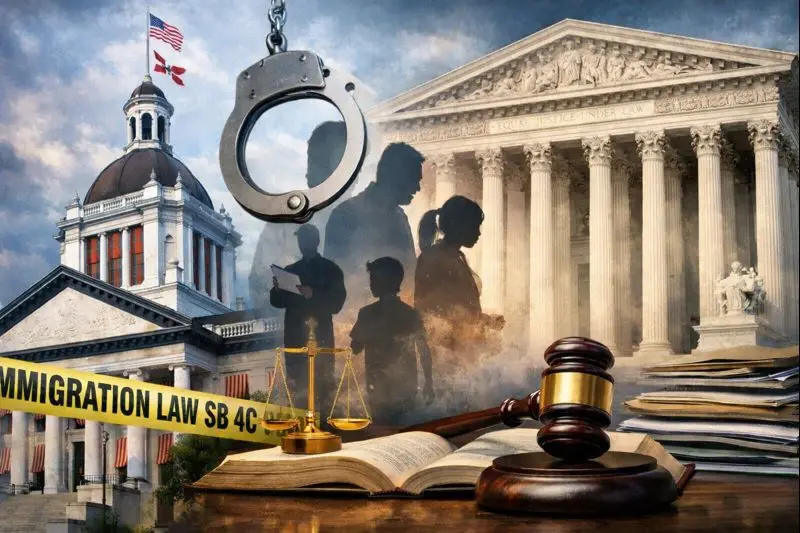
In early 2025, Florida became the center of a major national legal battle over immigration authority. The state passed Senate Bill 4C (SB 4C), one of the toughest immigration laws in the country, aimed at criminalizing undocumented entry and re-entry into Florida. The law promised mandatory detention, prison sentences, and expanded powers for local police to arrest individuals suspected of lacking legal immigration status.
However, before SB 4C could take effect, federal courts intervened. A sweeping Florida immigration law injunction stopped the law in its tracks, setting off appeals, emergency motions, and a high-profile refusal by the US Supreme Court to reinstate the statute.
This case is not just about Florida. It raises fundamental constitutional questions about who controls immigration policy in the United States, how far states can go in enforcing immigration laws, and what protections immigrants have under federal law. This article provides a complete breakdown of SB 4C, the court rulings, the legal reasoning behind the injunction, and why the outcome matters nationwide.
What Is Florida Immigration Law SB 4C?
Florida’s SB 4C, passed in February 2025, was designed to aggressively target undocumented immigrants entering or re-entering the state. Unlike previous state measures that focused on cooperation with federal authorities, SB 4C created new state crimes tied directly to immigration status.
Key Provisions of SB 4C
The law included several controversial elements:
- Criminal penalties for undocumented entry into Florida
- Mandatory detention for individuals charged under the law
- Prison sentences for repeat re-entry offenses
- Authority for local and state police to arrest based on suspected immigration status
- Restrictions on prosecutorial discretion
Supporters argued the law was necessary to deter unlawful migration and protect state resources. Florida officials claimed SB 4C mirrored federal immigration standards and addressed what they described as federal enforcement failures.
Why SB 4C Raised Immediate Alarms
Civil rights organizations, immigration attorneys, and advocacy groups quickly warned that SB 4C crossed constitutional lines. Critics argued that immigration enforcement is a federal responsibility, not a state one, and that allowing Florida to criminalize immigration status would create chaos.
Major concerns included:
- Racial profiling by local law enforcement
- Conflicts with federal immigration proceedings
- Mandatory detention without individualized review
- Chilling effects on immigrant communities, including lawful residents
These concerns led to swift legal action.
Who Challenged the Florida Immigration Law?
Shortly after SB 4C was signed, a coalition of organizations and individuals filed a federal lawsuit. Plaintiffs included:
- The Florida Immigrant Coalition
- The Farmworker Association of Florida
- Undocumented immigrants and mixed-status families
The lawsuit was supported by civil rights groups such as the ACLU and Americans for Immigrant Justice. Plaintiffs argued that SB 4C violated the US Constitution, conflicted with the Immigration and Nationality Act (INA), and endangered immigrant communities.
The District Court Steps In: Temporary Restraining Order and Preliminary Injunction
In April 2025, US District Judge Kathleen M. Williams, sitting in Miami, issued a temporary restraining order (TRO) blocking enforcement of SB 4C. Later that month, she followed with a detailed 49-page preliminary injunction.
Why the District Court Blocked SB 4C
Judge Williams ruled that the plaintiffs were likely to succeed on the merits of their claims. Her decision focused on several legal conflicts:
- SB 4C created a parallel state immigration enforcement system
- Mandatory detention conflicted with federal discretion
- State prosecutions could proceed even while federal immigration cases were pending
- The law undermined federal control over admission and removal of non-citizens
As a result, the Florida immigration law injunction prevented state officials from implementing or enforcing SB 4C while litigation continued.
Federal Preemption: The Core Legal Issue
At the heart of the injunction was the doctrine of federal preemption. Under the Supremacy Clause of the Constitution, federal law overrides conflicting state laws.
Immigration as a Federal Power
The court emphasized that immigration is governed by federal statutes, particularly the Immigration and Nationality Act (INA). Congress created a comprehensive framework regulating:
- Entry and admission
- Detention and release
- Removal proceedings
- Prosecutorial discretion
By criminalizing immigration status at the state level, Florida attempted to regulate an area already fully occupied by federal law.
Constitutional Concerns Beyond Preemption
The district court also identified serious constitutional risks if SB 4C were enforced.
Fourth Amendment Issues
Arrests based on suspected immigration status raised concerns about unlawful searches and seizures.
Due Process Violations
Mandatory detention without individualized review threatened basic due process protections.
Dormant Commerce Clause and Right to Travel
Criminalizing movement into Florida risked burdening interstate commerce and the constitutional right to travel freely between states.
These concerns further supported the Florida immigration law injunction.
Florida’s Appeal to the 11th Circuit Court
Florida immediately appealed the injunction to the 11th US Circuit Court of Appeals and asked for a stay that would allow SB 4C to take effect.
In June 2025, the 11th Circuit denied Florida’s request. The court concluded that:
- Federal law has a longstanding interest in immigration regulation
- SB 4C likely conflicts with federal statutes
- Florida had not shown a strong likelihood of success on appeal
The appellate court agreed to expedite review but kept the injunction in place.
The Supreme Court’s Emergency Decision
After losing in the 11th Circuit, Florida turned to the US Supreme Court, requesting emergency relief. The state asked the Court to allow SB 4C to be enforced while the case continued.
On July 9, 2025, the Supreme Court issued a brief unsigned order denying Florida’s request. There was no written opinion and no recorded dissent.
This decision left the Florida immigration law injunction fully intact, effectively keeping SB 4C on hold statewide.
Why the Supreme Court’s Refusal Matters
Although the Court did not explain its reasoning, legal experts interpreted the decision as a reaffirmation that:
- Immigration enforcement is primarily a federal function
- State laws creating independent immigration crimes face serious constitutional hurdles
The refusal signaled skepticism toward state efforts to bypass federal immigration authority.
Human Impact on Immigrant Communities
Even though SB 4C never went into effect, advocacy groups reported immediate harm.
Fear and Uncertainty
Immigrant families reported increased fear of detention and separation. Nonprofits documented surges in calls from anxious residents seeking legal advice.
Civil Rights Warnings
Organizations like Human Rights Watch warned that merging local policing with immigration enforcement leads to abuse, racial profiling, and erosion of trust.
The injunction was widely seen as a critical safeguard for vulnerable communities.
Contempt and Compliance: A Rare Legal Twist
The litigation also raised questions about compliance with court orders. Judge Williams ordered a review of whether Florida Attorney General James Uthmeier had encouraged enforcement of SB 4C despite the restraining order.
Such actions could constitute contempt of court, a serious issue that underscores the importance of respecting judicial authority. The episode highlighted a practical reality: injunctions protect rights only when officials comply with them.
Broader Legal and Policy Implications
The SB 4C case echoes the Supreme Court’s landmark decision in Arizona v. United States (2012), which limited state involvement in immigration enforcement.
National Significance
If states were allowed to enforce laws like SB 4C:
- Immigration enforcement would become fragmented
- Federal policy would lose uniformity
- Constitutional protections could erode
The Florida immigration law injunction sends a clear message that courts will not allow states to build parallel immigration regimes.
What Happens Next in the SB 4C Case?
The 11th Circuit Court of Appeals will hear full arguments on the merits of the case. Possible outcomes include:
- The injunction becomes permanent
- Portions of SB 4C are struck down
- The case returns to the Supreme Court
Until a final ruling is issued, SB 4C remains unenforceable across Florida.
Practical Guidance for Communities and Employers
- Immigrants should rely on trusted legal counsel and advocacy groups
- Employers should ensure policies comply with federal law and constitutional protections
- Journalists should prioritize court orders over political statements
Understanding the legal status of the injunction is critical to avoiding misinformation.
Why This Case Matters Beyond Florida
The litigation over SB 4C is about more than one state. It tests:
- The balance of power between state and federal governments
- The limits of immigration enforcement authority
- The role of courts in protecting constitutional rights
The outcome will influence future immigration legislation nationwide.
Final Thoughts
The Florida immigration law injunction represents a powerful reaffirmation of federal supremacy in immigration matters. By blocking SB 4C, courts preserved constitutional protections, prevented potential civil rights abuses, and maintained a uniform national immigration system.
As the case continues, it will remain a defining moment in the ongoing debate over immigration enforcement in the United States.
FAQs
What is Florida immigration law SB 4C?
SB 4C is a 2025 Florida law that criminalizes undocumented entry and re-entry, mandates detention, and grants state police immigration enforcement powers.
Why did the court block SB 4C?
Federal courts ruled the law likely conflicts with federal immigration statutes and violates constitutional principles such as federal supremacy and due process.
What did the US Supreme Court decide?
The Supreme Court denied Florida’s emergency request to enforce SB 4C, keeping the injunction in place.
Who challenged the Florida immigration law?
Immigrant advocacy groups and affected individuals, supported by organizations like the ACLU, filed the lawsuit.
How does the injunction affect immigrants in Florida?
The injunction prevents arrests, detention, and prosecution under SB 4C, offering protection to immigrant communities.
What happens next?
The 11th Circuit will decide whether the injunction becomes permanent. Until then, SB 4C remains blocked.